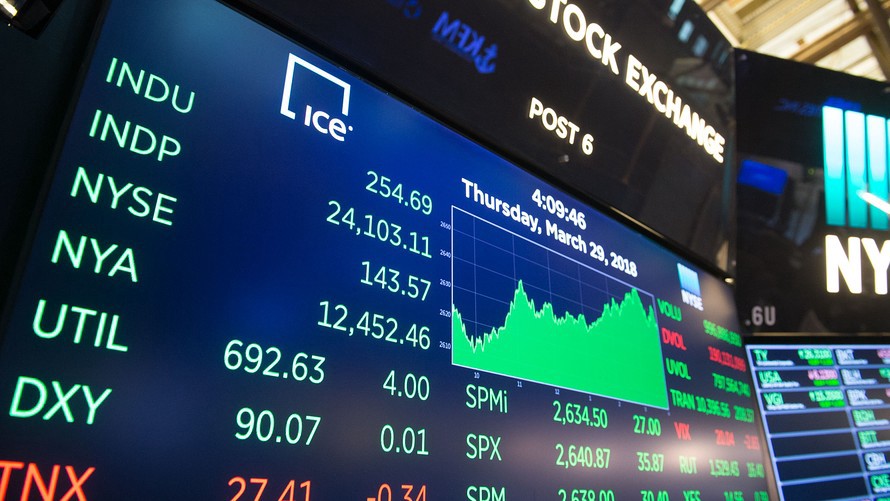
Project: Stock Market Analysis


Stock analysis is the method used by a trader or investor to examine and evaluate the stock market. It is then used to make informed decisions about buying and selling shares. Stock analysis can be used to gain an insight into the economy as a whole, the stock market, a specific sector, or an individual stock.

A time series is a series of data points indexed (or listed or graphed) in time order. Most commonly, a time series is a sequence taken at successive equally spaced points in time. Thus it is a sequence of discrete-time data. Examples of time series are heights of ocean tides, counts of sunspots, and the daily closing value of the Dow Jones Industrial Average.

Time series are very frequently plotted via line charts. Time series are used in statistics, signal processing, pattern recognition, econometrics, mathematical finance, weather forecasting, earthquake prediction, electroencephalography, control engineering, astronomy, communications engineering, and largely in any domain of applied science and engineering which involves temporal measurements.

Time series analysis comprises methods for analyzing time-series data in order to extract meaningful statistics and other characteristics of the data. Time series forecasting is the use of a model to predict future values based on previously observed values. While regression analysis is often employed in such a way as to test theories that the current values of one or more independent time series affect the current value of another time series, this type of analysis of time series is not called "time series analysis", which focuses on comparing values of a single time series or multiple dependent time series at different points in time. Interrupted time series analysis is the analysis of interventions on a single time series.

Let's look at the project at the Kaggle:  https://www.kaggle.com/samansiadati/stock-market-analysis

Comments

Popular posts from this blog

Which AWS Certifications Exist for AI? A Practical Map

 If you want to prove you can work with AI on AWS, the certification catalog can feel crowded. This post gives you a map: which credentials are aimed at AI, who each one is for, what the exams look like, and in which order a sensible person would take them. Every figure below comes from the official AWS certification pages as they stood on 25 October 2026, so always double-check the live pages before you book anything. The short version Two certifications are built squarely around AI on AWS, and they sit at opposite ends of the difficulty scale: AWS Certified AI Practitioner (AIF-C01) is the foundational, concept-level exam. AWS Certified Generative AI Developer – Professional (AIP-C01) is the advanced, build-it-in-production exam. Around them sits a ring of neighbouring certifications that make good stepping stones, plus a newer business-focused AI credential and a set of hands-on "Demonstrated" credentials. At a glance Detail AI Practitioner GenAI Developer ...

Artificial Neural Network

Artificial neural networks (ANN) or connectionist systems are computing systems vaguely inspired by the biological neural networks that constitute animal brains. The data structures and functionality of neural nets are designed to simulate associative memory. Neural nets learn by processing examples, each of which contains a known "input" and "result," forming probability-weighted associations between the two, which are stored within the data structure of the net itself. (The "input" here is more accurately called an input set, since it generally consists of multiple independent variables, rather than a single value.) Thus, the "learning" of a neural net from a given example is the difference in the state of the net before and after processing the example. After being given a sufficient number of examples, the net becomes capable of predicting results from inputs, using the associations built from the example set. If a feedback loop is prov...

Project: Heartbeat computing

In computer science, a heartbeat is a periodic signal generated by hardware or software to indicate normal operation or to synchronize other parts of a computer system. Usually, a heartbeat is sent between machines at a regular interval in the order of seconds; a heartbeat message. If the endpoint does not receive a heartbeat for a time—usually a few heartbeat intervals—the machine that should have sent the heartbeat is assumed to have failed. Heartbeat messages are typically sent non-stop on a periodic or recurring basis from the originator's start-up until the originator's shutdown. When the destination identifies a lack of heartbeat messages during an anticipated arrival period, the destination may determine that the originator has failed, shutdown, or is generally no longer available. Heartbeat messages may be used for high-availability and fault-tolerance purposes.